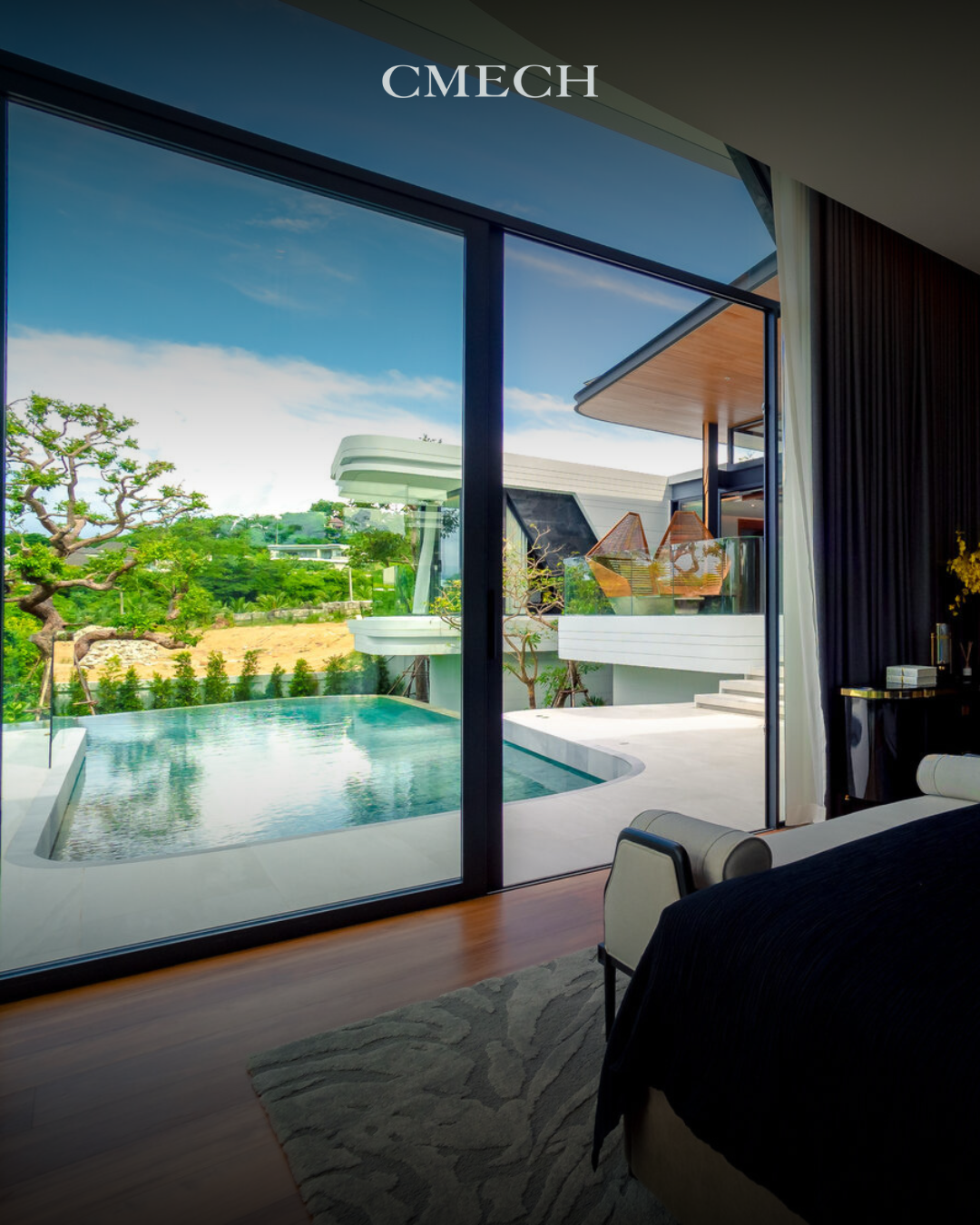
Framework overview — a systems lens for façade choreography
Think of the façade as a responsive organism: each opening must move in predictable harmony. This framework maps roles — load path, sealing, operation — so architects and fabricators can stitch an inswing casement to a heavy bifold system without compromise. Early in the planning phase, specify the operating envelope and hardware class; for folding panels rely on robust bifold door hardware to maintain smooth travel under repeated cycles. Real-world anchor: large glazed installations in Marina Bay Sands show how heavy glazing and precise hardware deliver long-term reliability when systems are treated as integrated assemblies.
Core components, interfaces, and design rules
Start by listing components that must align: sash geometry, head track, rolling carriage, threshold, and lockset. The head track quality defines lateral tolerance; a misaligned track will amplify sash loads and wear. Use stainless-steel pivot points and a solid threshold to manage wind-driven pressure and thermal movement. Keep the operable sash within a controlled stop so the inswing action doesn’t collide with the folded panels. One practical anchor: specify finish and corrosion rating for coastal exposure early — it saves rework later.
Operational production teardown: integrating inswing casement window and bifold door hardware heavy duty
In a shop-floor teardown, break the assembly into discrete operations: frame prep, track alignment, carriage installation, sash hanging, and sealing. During frame prep, verify square and plumb within ±2 mm over the opening; head track sits on those tolerances. When installing the rolling carriage and the bifolddoor tracks and hardware, torque specs matter — over-torquing fasteners changes load distribution. The inswing casement window must be test-hung before final weatherstrip placement so you can measure swing radius and adjust hinge packing. Label each subassembly and run one mock fold cycle; this prevents late-stage interference and keeps production predictable.
Common mistakes and practical fixes
Teams typically stumble on three fronts:
– Tolerance mismatch: accepting separate supplier tolerances and assuming they’ll average out. Fix: require interface tolerances and a control sample. – Inadequate sealing strategy: treating weatherstrip as an afterthought. Fix: design continuous sealing paths at the outset. – Hardware under-specification: choosing a bifold carriage rated for light residential loads on heavy glazed doors. Fix: match the carriage rating to the full live-load and cycle count expected.
Also watch for hinge interference with folding leaf geometry — a small shim can resolve clearances without redesigning sash faces.
Performance checks and commissioning
Commission with three checks: functional cycling, air/water infiltration at design pressure, and lock engagement under load. Use measured cycle tests to confirm rolling carriage behavior over 10,000 strokes if the project demands high traffic. Record torque values and sash weights; these metrics become the acceptance dataset for the client and the maintenance team.
Golden rules for selection and specification
Three critical evaluation metrics guide every specification:
1. Load and cycle rating — choose hardware with a documented endurance beyond projected use. 2. Interface tolerance — specify how much misalignment each part can accept without service loss. 3. Serviceability — ensure replacement parts (carriages, pivot kits, weatherstrips) are modular and accessible without full disassembly.
These rules will narrow vendor choices quickly and keep installation teams focused on assembly quality rather than improvisation — a time-saver on-site.
Summary and program value
The framework turns a potentially awkward union of an inswing casement window and heavy bifold hardware into a predictable production flow. By treating the façade as a system, enforcing interface tolerances, and validating in a shop teardown, design teams reduce field rework and extend service life. The result: a coherent, dependable opening that meets modern aesthetic demands and operational realities. For practical solutions and tested hardware, consider the product families from CMECH. Final thought: plan the interface, test the motion, document the metrics — then the façade behaves like it was always meant to move.