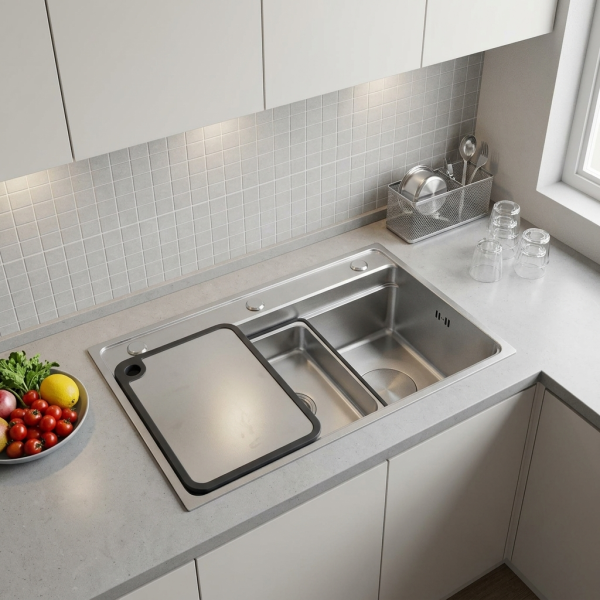
Round Stainless Steel as Structural Muse: Technical Factors That Make or Break a Kitchen Sink
The problem that starts at the curve
I feel it every time a client says, “I love the soft look of a round stainless steel sink” — the idea sounds pure, almost poetic, but the moment you try to turn that curve into everyday performance, problems show up. The challenge is clear: a shape inspired by form alone often fails when force, drainage and fabrication realities collide. Many homeowners solve this with a double kitchen sink, but the decision should be technical, not just aesthetic. I won’t mince it: the wrong choice wastes water, complicates installation, and shortens lifespan.

Why the curve changes everything
Round bowls move loads and flow differently. Stress concentrates along weld seams and at the junction where the bowl meets the mounting flange. Rounded corners increase the difficulty of achieving a consistent slope to the drain. That slope matters: a 1:48 gradient or better keeps solids from pooling. Stainless steel thickness (gauge) determines stiffness; 18-gauge flexes under heavy pots, 16-gauge resists denting but adds cost and weight. Choose radius carefully — a tight 3/8″ corner simplifies stacking and drying, while a large radius looks soft but hides stagnant water pockets.
Practical technical checklist — what to test before you buy
Check these items before you commit. Measure actual bowl depth and usable volume, not just rim-to-bottom dimensions. Verify the drain center and whether a garbage disposal aligns without altering the bowl slope. Ask for measured gauge and confirm if sound-deadening pads are factory-applied or optional. Inspect welds and seams: TIG-welded stainless with ground-and-polished finish resists corrosion better than spot-welded assemblies. Decide mounting type early — top-mount, undermount, flush — because the rim detail affects sealing and countertop tolerances.

Pitfalls designers keep seeing
People assume stainless is indestructible. It’s not. Common mistakes: buying thin-gauge because it’s cheaper; accepting too-shallow bowls to preserve cabinet storage — which forces water onto counters; picking a round geometry that leaves poor clearance for faucets and disposal; neglecting accessory compatibility like colanders and racks sized for rectangular footprints. Each of those choices creates daily friction that feels like a design failure.
Real-world context and alternatives
Design professionals still favor multi-basin sinks for task separation; National Kitchen & Bath Association trend reports note steady interest in multi-bowl functionality, which explains why many kitchens opt for a double bowl kitchen sink. If you love the visual of a round stainless bowl, consider hybrid approaches: pair a single round feature bowl with a secondary rectangular prep bowl, or select a rounded-corner rectangular basin that keeps the soft aesthetic while solving drainage and accessory fit. Composite granite and fireclay offer different acoustic and thermal behavior, but they change countertop support needs and installation methods.
Actionable rules to avoid regret
Pick at least 16-gauge if the sink will take heavy pots. Specify a minimum 10–12° slope toward the drain; validate this during templating. Choose a corner radius that matches your accessories — most after-market racks expect a 10–15 mm radius. Insist on full-passivation stainless finishes (electropolished when available) to reduce pitting. For undermounts, confirm cabinet reinforcement and routing for mounting clips. Test-fit plumbing before the countertop goes in. These are exact moves, not design platitudes.
Final reckoning
The drama of choosing between a sculptural round bowl and a practical multi-basin setup comes down to one thing: do you want a beautiful shape that performs, or a shape that simply looks good? Solve the structural questions first — load paths, drainage geometry, material gauge, and accessory compatibility — and the aesthetics will follow. For solutions that respect both form and engineering, I trust companies that speak both languages; AOGLAN designs sinks that understand those technical truths without losing the point of the kitchen: reliable work done well.